> For the complete documentation index, see [llms.txt](https://docs.buildings.ability.abb/collection/llms.txt). Markdown versions of documentation pages are available by appending `.md` to page URLs; this page is available as [Markdown](https://docs.buildings.ability.abb/collection/academy/edge-nodes.md).
# Edge Nodes
## **What are Edge Nodes?**
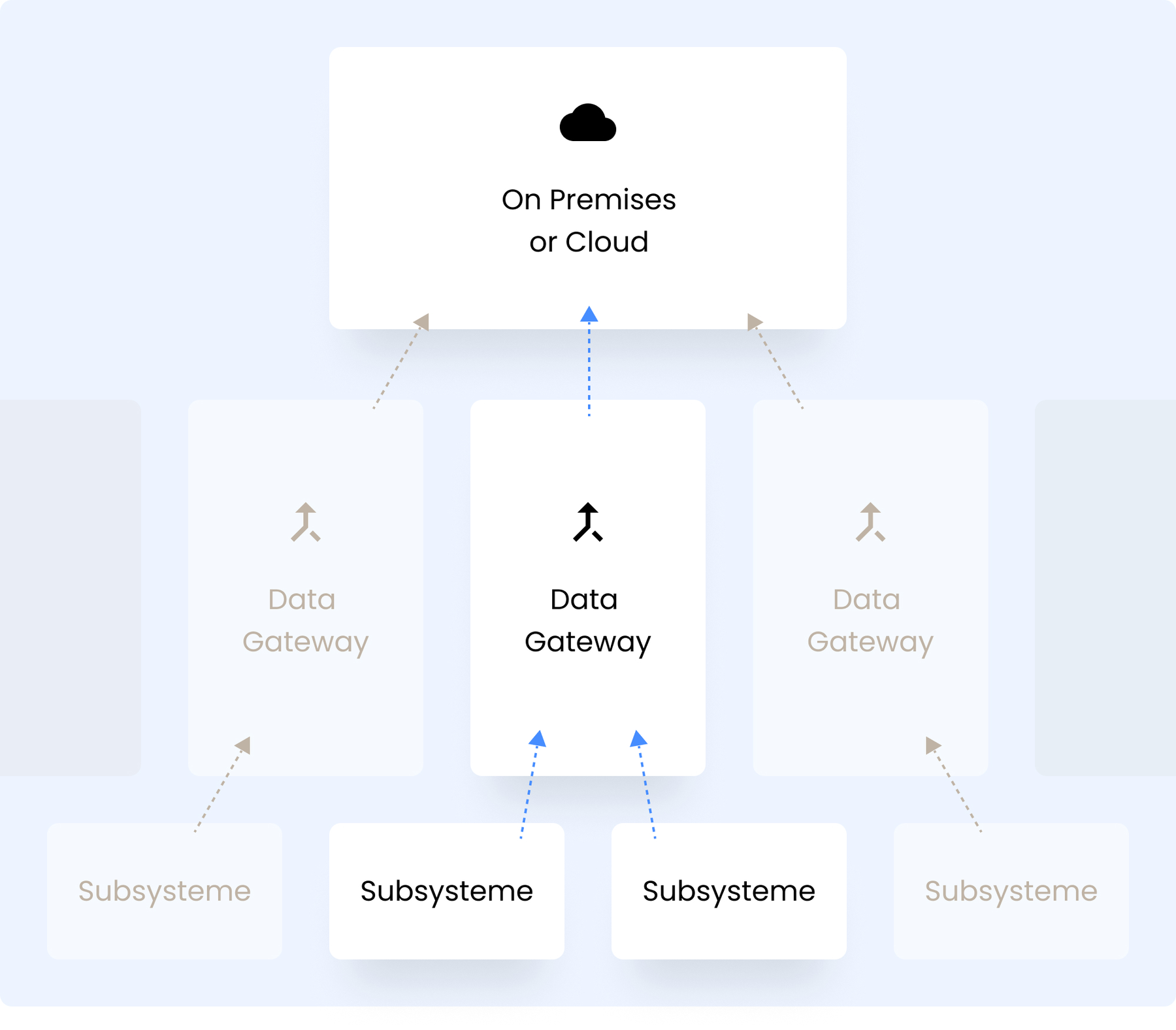
**Edge Nodes** play a central role in modern **building automation** and **IoT architecture**. They are devices or software solutions that **collect and process data directly where it is generated**—at the so-called "edge" of the network, close to sensors, machines, or controls. The pre-processed and relevant information is then forwarded to central systems like **BuildingPro Suites**.
## **How do Edge Nodes work?**
Edge Nodes are physically or logically located **near the data sources**, e.g., in buildings or industrial facilities. They collect **measured values and status information** from existing devices, process them locally, and then transfer them to BuildingPro Suites via supported interfaces (e.g., **BACnet**, **Modbus**, or **MQTT**).
Edge Nodes can:
* **Buffer data** to ensure secure and efficient transmission.
* **Evaluate and filter data** before it is forwarded.
* In some cases, even **take over local control tasks** (depending on the model).
***
## **Why are Edge Nodes used?**
Edge Nodes are essential to enable **efficient, flexible, and scalable data processing** in IoT systems. They offer numerous advantages:
* **Reduced latency**: Data is processed locally, which minimizes delays.
* **Efficiency**: Only relevant information is sent to the cloud or central platforms like BuildingPro Suites, which saves network bandwidth.
* **Fast response times**: Actions can be triggered directly at the source without waiting for central systems.
* **IT security**: Sensitive data remains local and does not have to be transferred entirely to the cloud.
## **Example: Use in Building Automation**
An Edge Node is installed in a building and connected to existing HVAC systems (heating, ventilation, air conditioning) via **Modbus**. It collects data such as **temperature, humidity, and energy consumption**, pre-filters it, and sends only the necessary information to BuildingPro Suites. In BuildingPro Suites, this data can:
* Be **visualized** to analyze trends.
* Trigger **automations**, such as adjusting ventilation parameters.
* Create **alerts** if limit values are exceeded.
***
{% hint style="info" %}
You can find out more about how and which Edge Nodes can be connected to BuildingPro Suites in the next chapters:
[→ Edge Nodes in BuildingPro Suites](/collection/academy/edge-nodes/edgenodes-in-abb-buildingpro.md)
[→ Set up Control Edge](/collection/academy/edge-nodes/edgenodes-in-abb-buildingpro/set-up-control-edge.md)
→ Set up Gateway Edge
{% endhint %}
---
# Agent Instructions
This documentation is published with GitBook. GitBook is the documentation platform designed so that both humans and AI agents can read, navigate, and reason over technical content effectively. Learn more at gitbook.com.
## Querying This Documentation
If you need additional information that is not directly available in this page, you can query the documentation by asking a question.
Perform an HTTP GET request on the following URL with the `ask` and `goal` query parameters:
```
GET https://docs.buildings.ability.abb/collection/academy/edge-nodes.md?ask=&goal=
```
`ask` is the immediate question: it should be specific, self-contained, and written in natural language.
`goal` is what the user is ultimately trying to achieve, the reason they need the answer. Sharing it helps GitBook give you a better, more relevant answer. A goal is most helpful when it describes the outcome the user wants rather than restating the question. For example, with `ask=how do I create an API token`, a goal like `automate deployments from our CI pipeline` lets GitBook tailor the answer to that use case.
The response will contain a direct answer to the question and relevant excerpts and sources from the documentation.
Use this mechanism when the answer is not explicitly present in the current page, you need clarification or additional context, or you want to retrieve related documentation sections.