> For the complete documentation index, see [llms.txt](https://docs.buildings.ability.abb/collection/llms.txt). Markdown versions of documentation pages are available by appending `.md` to page URLs; this page is available as [Markdown](https://docs.buildings.ability.abb/collection/english-v14/academy/einfuhrung-in-ontologien/einfuhrung-in-die-brick-ontologie.md).
# Introduction to the Brick ontology
## Introduction
Brick is a standardized ontology specifically developed for building automation and the management of building data. The goal of Brick is to provide a uniform and standardized description of building systems and devices. This facilitates the integration and exchange of data between different systems and applications in smart buildings.
***
## Components of the [Brick Ontology](https://brickschema.org/)
The Brick ontology comprises several essential components that are used to describe and manage building data:
* **Classes**
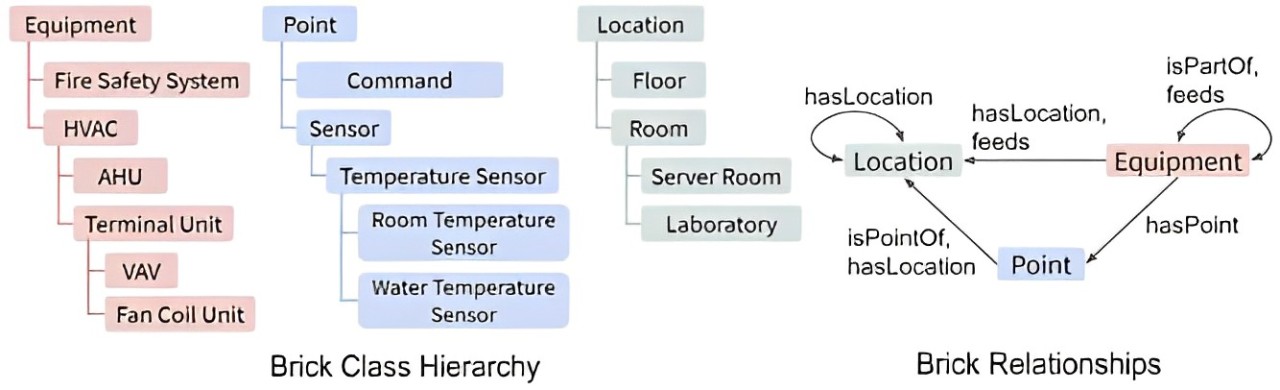
In Brick there are a variety of classes that represent different elements of a building, such as rooms, equipment, sensors, and systems. Important classes include:
* **Equipment**: equipment and systems in the building, such as Fire Safety System, HVAC, AHU (Air Handling Unit), Terminal Unit, VAV (Variable Air Volume), Fan Coil Unit.
* **Point**: data points associated with the equipment, such as Command and Sensor.
* **Sensor**: special type of Point, such as Temperature Sensor (temperature sensor), Room Temperature Sensor (room temperature sensor), Water Temperature Sensor (water temperature sensor).
* **Location**: describes various locations within the building, such as Floor, Room, Server Room, Laboratory.
* **Instances**: These are concrete examples of classes. For example, a specific room in the building could be modeled as an instance of the class 'Room'.
* **Attributes**: Brick defines attributes that describe specific characteristics or properties of classes and instances. An attribute could, for example, be the current temperature in a room.
* **Relations**
These describe the relationships between different classes and instances. Important relations include:
* **hasLocation**: A relationship indicating that equipment has a location.
* **hasPoint**: A relationship indicating that equipment has data points.
* **isPartOf**: A relationship describing the belonging of equipment to a larger system.
* **feeds**: A relationship describing the data flow from one device to another.
* **isPointOf**: A relationship indicating that a data point is assigned to a specific location.
* **hasLocation**: A relationship indicating that a point or a device is at a specific location.
***
## Strengths of the Brick Ontology
* **Improved interoperability**: Brick offers a standardized description language that facilitates the integration and exchange of data between different systems and applications. This promotes collaboration and data exchange in smart buildings.
* **Efficient data management**: The ontology enables structured and efficient management of building data, which greatly simplifies the use and analysis of this data.
* **Certain flexibility and adaptability**: Brick is modular and flexible in design, which makes it easier to adapt to specific requirements and use cases. New classes and relationships can be added easily without affecting the existing structure.
## Weaknesses of the Brick Ontology
* **Complexity of implementation**: The implementation of the Brick ontology can be complex and time-consuming due to its comprehensive structure and the large number of classes and relations. This requires specialized knowledge and resources.
* **Training and knowledge**: Using and adapting the Brick ontology requires a certain learning curve and training. A sound understanding of the ontology is needed in order to use it effectively.
* **Incompatibility with older systems**: In some cases, it can be difficult to integrate older systems and data into the Brick ontology. This may require additional adjustments and conversions, which can complicate the implementation process.
* **Costs for customization and maintenance**: Customizing and maintaining the ontology can be costly, especially when specific adjustments are required for individual needs. This poses a challenge, particularly for organizations with limited resources.
#### Conclusion
The Brick ontology is a powerful and flexible solution for describing and managing building data in smart buildings. By using it, buildings can be operated and managed more efficiently, leading to optimized operations and lower energy consumption. As a standardized ontology, Brick facilitates integration and interoperability between different systems and applications. However, implementation and maintenance can be costly and time-consuming due to the extensive structure and complexity.
In the next chapter, we will take a closer look at the RealEstateCore ontology and its relevance for smart buildings.
---
# Agent Instructions
This documentation is published with GitBook. GitBook is the documentation platform designed so that both humans and AI agents can read, navigate, and reason over technical content effectively. Learn more at gitbook.com.
## Querying This Documentation
If you need additional information that is not directly available in this page, you can query the documentation by asking a question.
Perform an HTTP GET request on the following URL with the `ask` and `goal` query parameters:
```
GET https://docs.buildings.ability.abb/collection/english-v14/academy/einfuhrung-in-ontologien/einfuhrung-in-die-brick-ontologie.md?ask=&goal=
```
`ask` is the immediate question: it should be specific, self-contained, and written in natural language.
`goal` is what the user is ultimately trying to achieve, the reason they need the answer. Sharing it helps GitBook give you a better, more relevant answer. A goal is most helpful when it describes the outcome the user wants rather than restating the question. For example, with `ask=how do I create an API token`, a goal like `automate deployments from our CI pipeline` lets GitBook tailor the answer to that use case.
The response will contain a direct answer to the question and relevant excerpts and sources from the documentation.
Use this mechanism when the answer is not explicitly present in the current page, you need clarification or additional context, or you want to retrieve related documentation sections.