> For the complete documentation index, see [llms.txt](https://docs.buildings.ability.abb/collection/llms.txt). Markdown versions of documentation pages are available by appending `.md` to page URLs; this page is available as [Markdown](https://docs.buildings.ability.abb/collection/english-v14/academy/einfuhrung-in-ontologien/einfuhrung-in-die-realestatecore-ontologie.md).
# Introduction to the RealEstateCore ontology
## Introduction
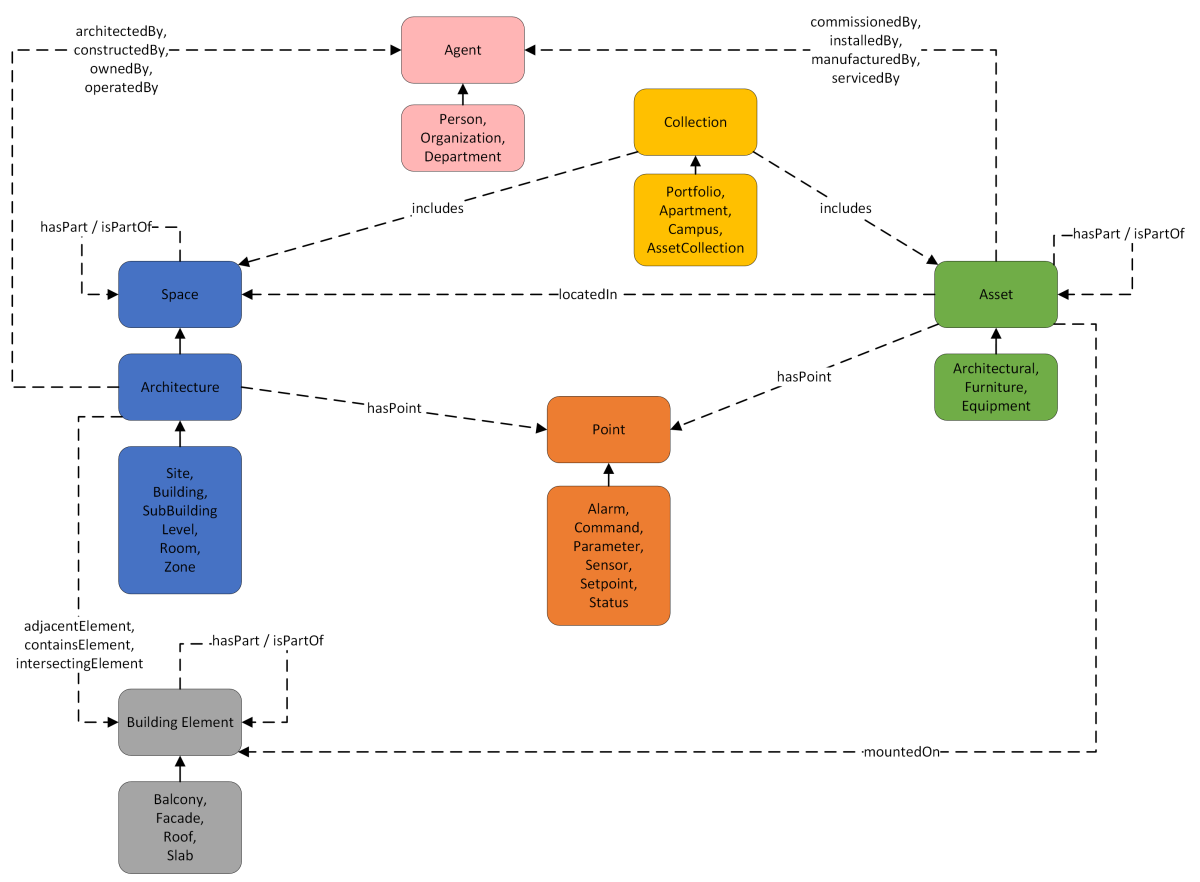
RealEstateCore is a standardized ontology developed specifically for the real estate industry and the management of building data. It provides a comprehensive data model for describing buildings, their use, and operation. RealEstateCore aims to provide a common language and structure for the real estate industry to facilitate the integration and use of data.
***
## Components of the [RealEstateCore Ontology](https://www.realestatecore.io/introduction/)
The RealEstateCore ontology consists of several core components used to describe and manage building data:
1. **Classes**: RealEstateCore defines a variety of classes that cover different aspects of real estate and their operation, such as:
* **Buildings**: Structures such as buildings and their parts.
* **Rooms**: Individual rooms within a building.
* **Equipment**: Devices and systems operated in a building.
* **Systems**: The totality of equipment and fixtures.
* **User**: Persons or organizations that interact with the building.
2. **Instances**: These are concrete examples of classes. A specific building or a particular room in a building would be an instance of the corresponding class.
3. **Attributes**: RealEstateCore defines attributes that describe specific features or properties of classes and instances. For example, an attribute could be the area of a room or the energy efficiency of a building.
4. **Relations**: These describe the relationships between different classes and instances. Important relations include:
* **is part of**: This relation describes the belonging of a room to a specific building.
* **has location**: Links an object to its physical location.
* **contains**: Describes that a certain object contains other objects.
***
## **Strengths of RealEstateCore**
1. **Industry-specific focus**: RealEstateCore is specifically tailored to the real estate industry and offers terminology and structure that are well understood in this sector. This greatly facilitates adoption and application.
2. **Comprehensive coverage of business processes**: The ontology covers a broad range of aspects in building management, from technical infrastructure and operations to financial and leasing processes. This enables holistic management of building data.
3. **Flexibility and extensibility**: RealEstateCore has a modular structure, which makes it easy to extend and adapt to specific requirements and use cases. New concepts and relationships can be added without difficulty.
4. **Interoperability**: By using standardized terms and structures, RealEstateCore improves interoperability between different systems and applications. This promotes data exchange and integration, which is especially important for networking and collaboration in smart buildings.
## **Weaknesses of RealEstateCore**
1. **Complexity of implementation**: Implementing RealEstateCore can be complex and time-consuming due to its extensive structure and large number of concepts. This requires specialized knowledge and resources, which can make getting started difficult.
2. **Training and learning curve**: Using RealEstateCore requires a certain learning curve and training. Employees must become familiar with the ontology, which requires additional training effort and time.
3. **Integration of legacy systems**: Integrating legacy systems and data into RealEstateCore can be difficult and may require additional adjustments and conversions, which can complicate the implementation process.
4. **Costs for customization and maintenance**: Adapting and maintaining the ontology can be costly, especially when specific adjustments for individual requirements are needed. This poses a challenge, particularly for smaller organizations with limited resources.
***
## Conclusion
RealEstateCore offers a specialized and comprehensive solution for managing building data in the real estate industry. Its industry-specific focus and broad coverage of business processes make it particularly useful for comprehensive building management applications. However, implementation and maintenance can be complex and costly. The choice of RealEstateCore should therefore be based on a careful consideration of the specific requirements and available resources. In the next section, we will look at the specific implementation of Eliona and explain how these principles are used to ensure effective management of smart buildings.
---
# Agent Instructions
This documentation is published with GitBook. GitBook is the documentation platform designed so that both humans and AI agents can read, navigate, and reason over technical content effectively. Learn more at gitbook.com.
## Querying This Documentation
If you need additional information that is not directly available in this page, you can query the documentation dynamically by asking a question.
Perform an HTTP GET request on the current page URL with the `ask` query parameter, and the optional `goal` query parameter:
```
GET https://docs.buildings.ability.abb/collection/english-v14/academy/einfuhrung-in-ontologien/einfuhrung-in-die-realestatecore-ontologie.md?ask=&goal=
```
`ask` is the immediate question: it should be specific, self-contained, and written in natural language.
`goal` is optional and describes the broader end goal you are ultimately trying to accomplish on behalf of the user. GitBook uses it to tailor the answer towards what is most useful for that goal.
The response will contain a direct answer to the question and relevant excerpts and sources from the documentation.
Use this mechanism when the answer is not explicitly present in the current page, you need clarification or additional context, or you want to retrieve related documentation sections.