

How Eliona covers ontologies
Introduction
Eliona is a versatile and scalable platform that integrates ontologies such as Brick, Haystack, and RealEstateCore to enable efficient and user-friendly management of smart buildings. With its powerful functions and intuitive user interface, Eliona supports the structuring, integration, and management of building data in a way that promotes both flexibility and efficiency. This documentation provides a comprehensive overview of Eliona's structure and functions, including the use of tag systems, the creation of custom classes (Asset Templates), the geographical and functional nesting of assets, as well as advanced asset functions and data integration methods. By combining practical solutions and innovative technologies, Eliona ensures that smart buildings can be managed optimally and continuously developed further.
Structure of Eliona
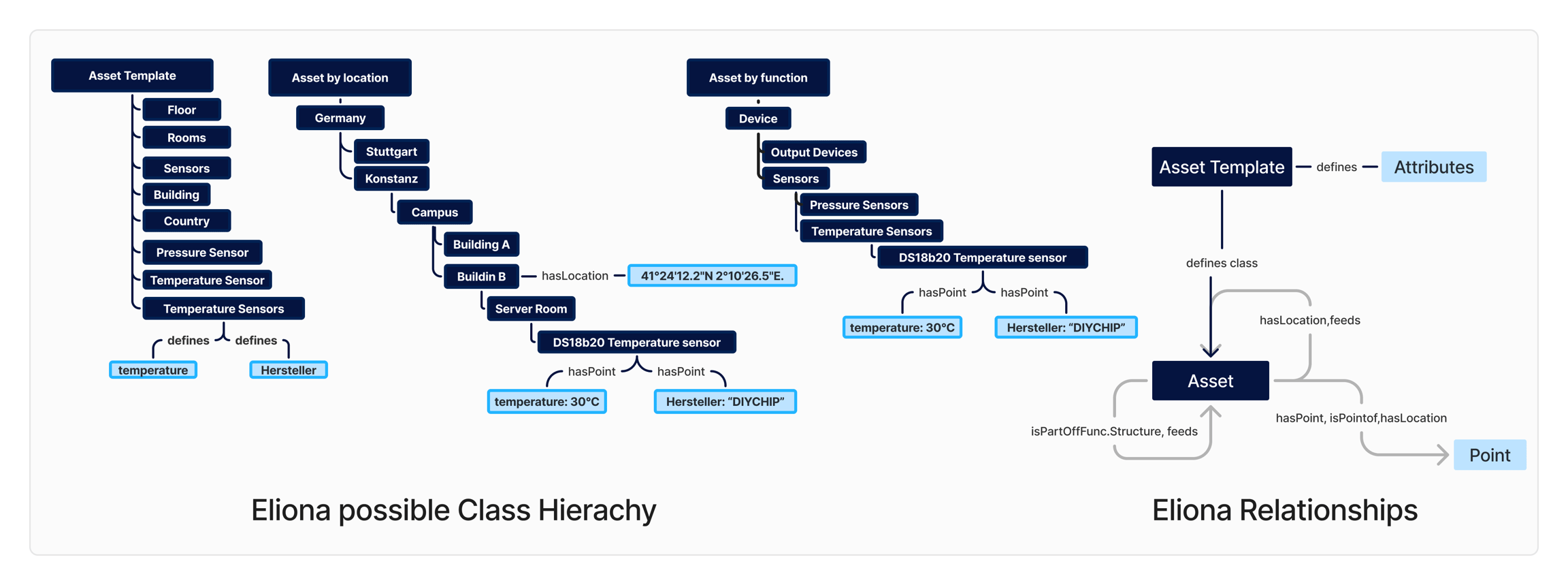
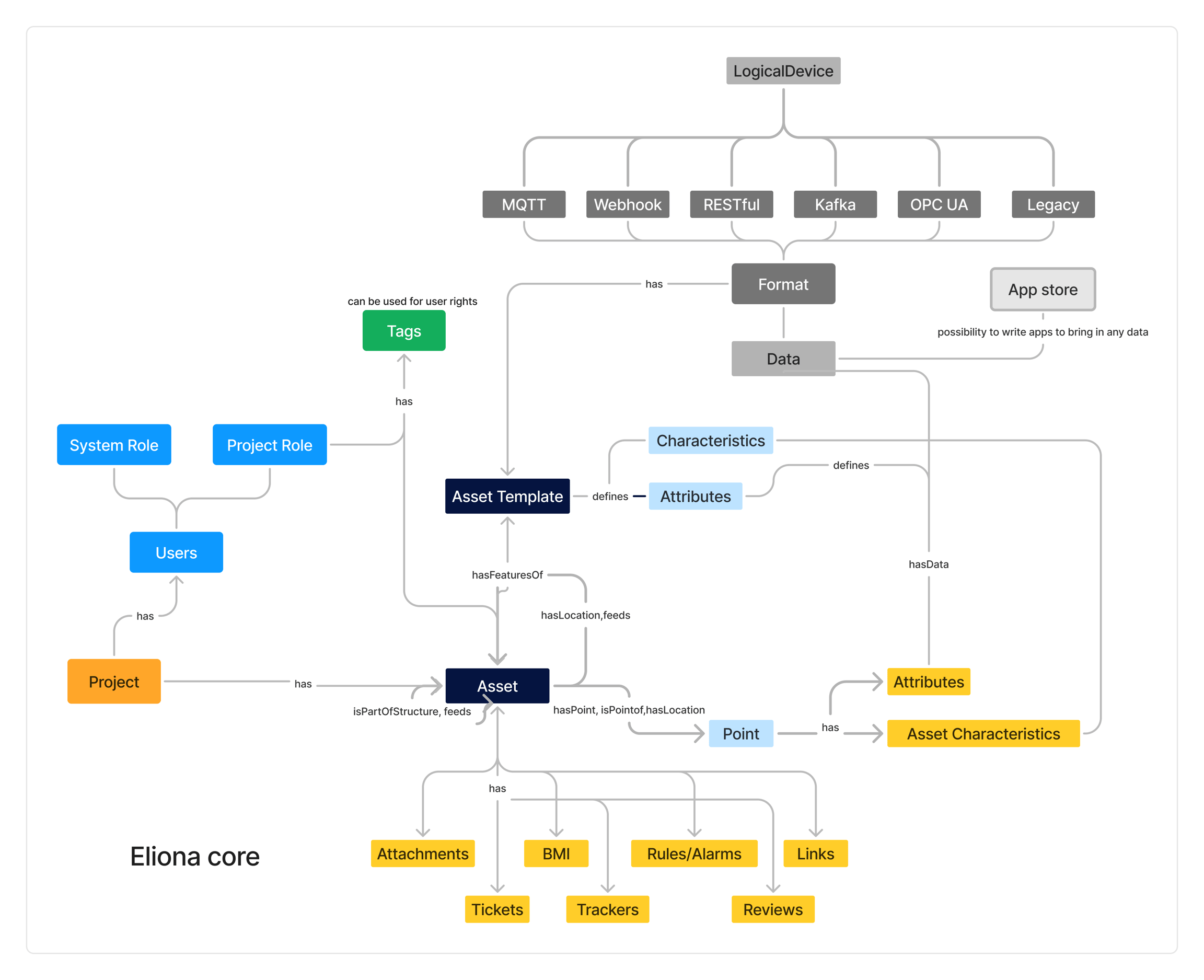
Eliona is a flexible and scalable platform that uses various building blocks from ontologies such as Brick, Haystack, and RealEstateCore. Here is a general and clear representation of how Eliona is structured:
Tag system
Eliona uses a tag system similar to Haystack. Tags can be assigned to easily identify and organize data points, devices, and assets. These tags can be used in a variety of ways:
Rules for alarms and escalations: Tags can be used to define rules for alarms and escalations.
Access rights: Tags determine which users have which rights to which assets. User roles can also be assigned tags to control access.
Custom classes (Asset Templates)
Eliona offers the possibility to create custom classes (Asset Templates) and assign attributes to them. The templates can represent anything from rooms and buildings to specific types of sensors or abstract concepts. Users can therefore create their own templates (classes) and define for themselves which attributes they have, and even create new attributes that are calculated from others.
Instances (Assets)
The created templates are turned into concrete instances (assets). For example:
Room 001
Heat sensor 001
These instances can also be assigned tags, which can then be used for various purposes.
Nesting of assets
Assets can be nested geographically and/or functionally by dragging and dropping them into one another. For example:
Sensor Temp 001 can be nested in Room 001 nested.
Room 001 can be nested in Building A nested.
Advanced asset functions
Similar to Brick, assets in Eliona can have various points:
Reviews
Tracker
Attributes and asset characteristics (inherited from the Asset Template)
Data integration and Drag-and-drop formats
Eliona enables the quick creation of drag-and-drop formats that integrate incoming data into an asset. These formats can be used when connecting MQTT, webhooks, RESTful, Kafka, UDP, UA, Modbus, and legacy systems to integrate data into asset attributes, such as a temperature measurement.
App store and scalability
Eliona offers an app store in which apps can be created efficiently, and which also supports other integrations into the platform. All data is stored in a PostgreSQL database, ensuring high scalability and efficiency. Eliona is a web application.
Interoperability and Bulk import
Interoperability can be provided through an app as an interface. However, there is also the option of bulk import, in which data can be imported in JSON format. API connectivity also enables the integration of data into the platform.
Ticket system
Eliona has a ticket system in which tags can be used and assets assigned.
Use of AKS
In an asset's geoinformation (GAI), AKS can be used to convey detailed information at a glance in a string.
Eliona and the use of ontologies
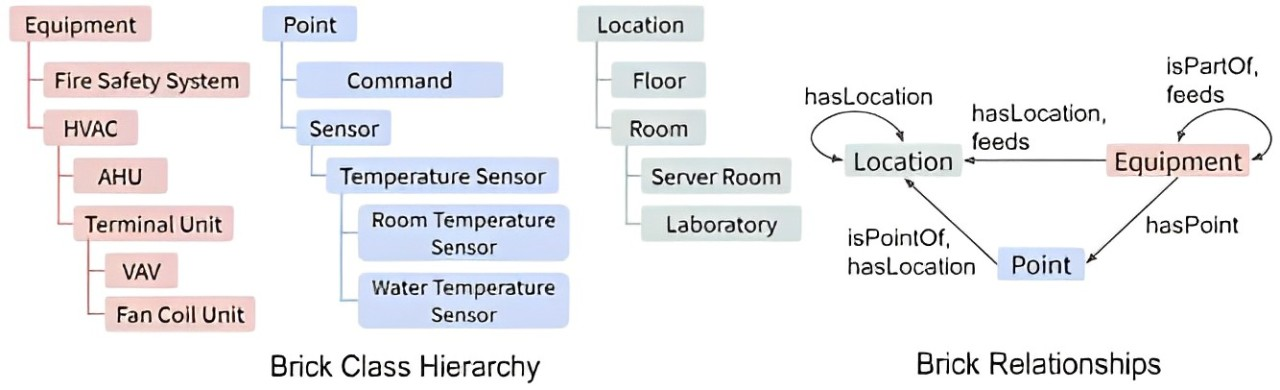
Brick
Components of Brick in Eliona:
Points: Eliona integrates the concept of "points" from Brick to organize various data points and measured values. These points can represent sensor values, device states, or other relevant information.
Nesting of assets: Eliona enables the geographical and functional nesting of assets, similar to how Brick structures rooms, zones, and buildings.
Asset attributes: The attributes of assets in Eliona are inspired by the detailed and specific attributes that Brick defines for various building objects.
Advantages of using Brick:
Structured data organization: Brick's clear structure makes it easier to organize and manage building data.
Easy navigation and visualization: The nesting of assets enables intuitive navigation and visualization of the building structure and its components.
Extensibility: The use of points and attributes allows flexible expansion and adaptation to specific requirements.
Haystack
Components of Haystack in Eliona:
Tag system: Eliona adopts Haystack's tagging system, which makes it possible to assign tags and thus easily identify and organize data points, devices, and assets.
Flexibility in data acquisition: Eliona uses Haystack's flexibility to integrate and process incoming data quickly and efficiently.
Rule-based automation: By using tags, rules for alarms and escalations can be defined in Eliona, enabling an automated response to specific events.
Advantages of using Haystack:
Simplicity and flexibility: The tagging system makes it easier to identify and organize data without complex hierarchies.
Efficient data integration: Haystack's flexible structure enables the fast integration and processing of data from various sources.
Automation: The rule-based automation improves the responsiveness and efficiency of building management.
Manage user rights: Tags can be used to control users' access rights to different assets.
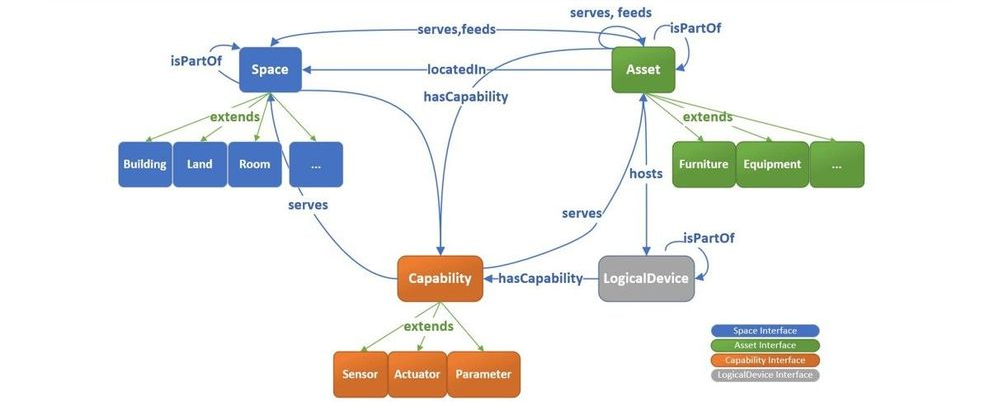
RealEstateCore
Components of RealEstateCore in Eliona:
Classes and instances: Eliona uses the concept of classes and instances from RealEstateCore to create specific asset templates, which can then be turned into concrete instances.
Users (Agents): Similar to how RealEstateCore uses the concept of agents to define various users and their roles, Eliona offers a flexible system for managing user roles and access rights.
Interoperability: Eliona uses the interoperability standards of RealEstateCore to facilitate communication and integration between different systems.
Advantages of using RealEstateCore:
Standardization: Standardized terminology ensures consistency and clarity in data management.
Interoperability: Using interoperability standards makes it easier to integrate and communicate between different systems and platforms.
Flexibility and adaptability: The ability to define custom classes and instances allows a high degree of adaptability to specific requirements and use cases.
User management: The management of users and their access rights is supported by a flexible and efficient system based on the concept of agents in RealEstateCore.
Problem solving through Eliona
Eliona uses ontologies such as Brick, Haystack, and RealEstateCore to address specific challenges in the smart building context. At the same time, Eliona overcomes the weaknesses of ontologies by providing a flexible and user-friendly platform.
Knowledge management
Problem: Extensive and complex data sets in smart buildings are difficult to organize and search through. Solution through Eliona:
Tag system: By using a flexible tag system that makes it possible to identify and organize data points, devices, and assets, Eliona improves the management and searchability of data.
Clear structuring: Eliona enables the creation of custom classes (Asset Templates) and their instances, resulting in clear and consistent data organization.
Geographical and structural nesting: The nesting of assets makes organization and searchability easier.
Data integration
Problem: Data in smart buildings comes from various sources and systems that are often incompatible with one another. Solution through Eliona:
Common language: Eliona uses standardized terms and structures that enable seamless integration of data from different sources.
Flexible formats: The rapid creation of drag-and-drop formats for integrating data via MQTT, webhooks, RESTful, Kafka, UDP, UA, Modbus, and legacy systems simplifies data integration.
Interoperability
Problem: Different systems and devices in smart buildings often cannot communicate effectively with one another. Solution through Eliona:
Standardized relationships: By using ontology standards, Eliona promotes interoperability between different systems and devices.
Flexibility: The ability to define and nest custom classes and instances enables effective communication and collaboration between different systems.
Semantic web services
Problem: The integration and use of web services in smart buildings is often complicated and inflexible. Solution through Eliona:
Semantic annotation: Eliona enables semantic annotation of web services, which makes it easier to search for, access, and integrate web services.
App store: Eliona's app store supports the creation and integration of apps that use various web services and other integrations.
Adaptability and flexibility
Problem: Systems in smart buildings must be able to adapt to changing requirements and technological advances. Solution through Eliona:
Extensibility: The ability to integrate new classes and relationships into the existing framework enables a high degree of adaptability.
Drag-and-drop functionality: The easy customization and expansion of data formats and integrations supports continuous innovation and adaptation.
Solutions for weaknesses of ontologies
Complexity
Weakness: Creating and maintaining ontologies is complex and requires extensive knowledge. Solution through Eliona:
User-friendliness: Eliona offers an intuitive user interface and drag-and-drop functions that simplify the creation and maintenance of data structures.
Automation: The platform automates many of the complex processes associated with managing ontologies.
Costs
Weakness: Developing and implementing ontologies is associated with high costs. Solution through Eliona:
Cost efficiency: Eliona reduces costs through user-friendly tools and templates that reduce the need for specialized experts and expensive software tools.
Scalability: Using a scalable PostgreSQL database ensures cost efficiency as data volumes grow.
Inflexibility
Weakness: Ontologies are often rigid and difficult to change. Solution through Eliona:
Flexibility: Eliona enables quick adjustments and extensions of classes and relationships, making changes easy to implement.
Dynamic adaptation: The platform supports continuous adaptation to new requirements and technological advances.
Acceptance
Weakness: Ontologies are often seen as too theoretical and impractical. Solution through Eliona:
Practical application: Eliona provides practical solutions through intuitive user interfaces and application-oriented functions.
Communicating the benefits: Clear presentation and ease of use promote acceptance of the platform.
Maintenance and updates
Weakness: The continuous maintenance and updating of ontologies is challenging. Solution through Eliona:
Easy maintenance: Eliona automates many maintenance processes and offers simple tools for updating data structures.
Regular updates: The platform supports regular updates and adaptation to changing requirements.
Compatibility and standardization
Weakness: Differences in terminology and structure between different ontologies and systems. Solution through Eliona:
Standardized terminology: Eliona uses standardized terms and structures to improve compatibility.
Interoperability standards: The platform promotes integration and communication between different systems through the use of interoperability standards.
Scalability
Weakness: Difficulties in scaling to very large data volumes and complex systems. Solution through Eliona:
Scalable architecture: Using a scalable PostgreSQL database enables efficient management of large amounts of data.
Powerful query functions: Eliona offers powerful tools for querying and processing data, even in large and complex systems.
Conclusion
Eliona uses ontologies such as Brick, Haystack, and RealEstateCore to address specific challenges in the smart building context while also overcoming their weaknesses. By combining flexible tag systems, the ability to create custom classes and instances, the nesting of assets, advanced asset functions, efficient data integration, and automated processes, Eliona offers a scalable, user-friendly, and adaptable platform. This makes it easier to organize, integrate, and manage data in smart buildings and supports continuous innovation and adaptation.
Last updated
Was this helpful?