

🕵️Filter
The filter service offers a comprehensive selection of filters that can be applied to incoming data. These filters are designed to increase the quality and relevance of the stored data by allowing only significant changes and important information through. Data is only stored in the database once it has passed through the filter, which means the filter is applied to the value only after calculation.
This ensures that only relevant data points are captured, increasing the efficiency of data processing and storage.
Supported filter types
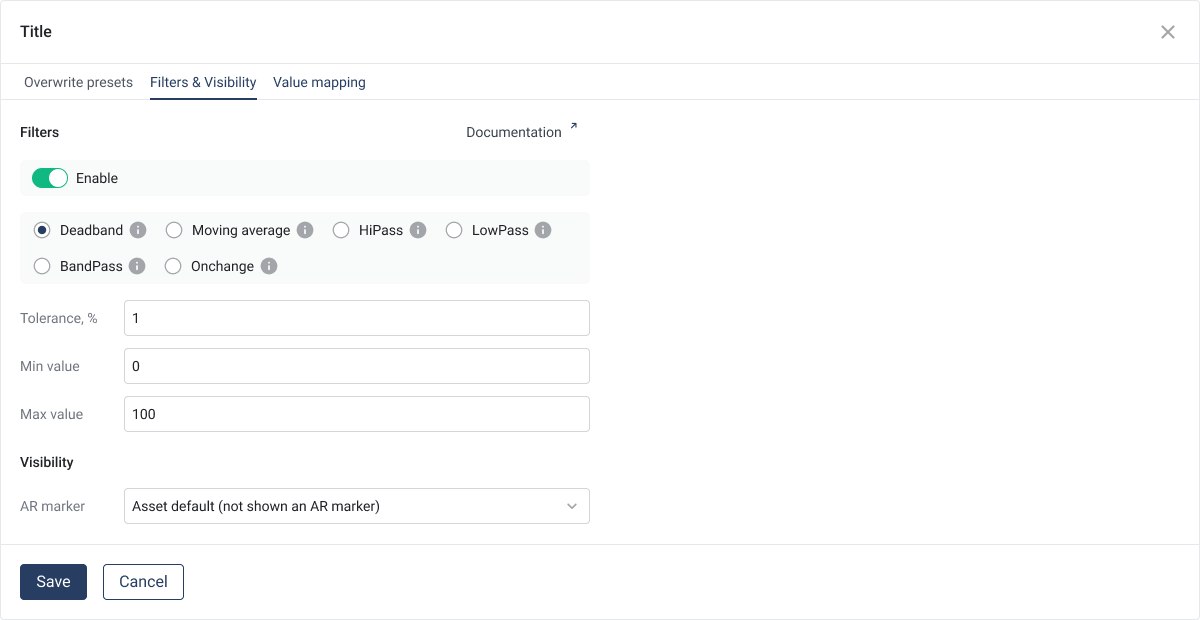
1. Deadband filter (Deadband)
The Deadband filter stores only values when the value after calculation differs significantly from the previous one. The change is defined by the following formula:
Formula:
A new value is only saved if the absolute difference from the previous value is greater than or equal to Epsilon is:
Example:
Tolerance: 5 %
Maximum value: 100 °C
Minimum value: 0 °C
Epsilon:
Incoming values: 20 °C → 21.5 °C → 23 °C → 24.4 °C → 26 °C
Result:
20 °C is saved (first value).
21.5 °C is not saved because the change |21.5 - 20| = 1.5 < 2.5 is not sufficient.
23 °C is saved because |23 - 20| = 3 ≥ 2.5
24.4 °C is not saved because |24.4 - 23| = 1.4 < 2.5
26 °C is saved because |26 - 23| = 3.0 ≥ 2.5
2. Moving average filter (Moving Average)
The Moving average filters does not store the original values, but rather the average of a defined number of consecutive values (window sizsse).
How it works:
The filter collects values within a defined window.
Once the window size is reached, the average of the values is calculated and stored.
The window is then shifted by one value, and the process repeats.
Example:
Window size: 3 values
Incoming values: 12 V → 15 V → 18 V → 21 V → 24 V
Calculations:
Average of the first 3 values (12 V, 15 V, 18 V):
Average of the next 3 values (18 V, 21 V, 24 V):
Stored values: 15 V, 18 V, 21 V.
3. High-pass filter
The high-pass filter stores only values that are strictly higher than a defined limit. This is ideal for monitoring threshold exceedances.
Example:
Limit: 50 kW
Incoming values: 45 kW → 52 kW → 48 kW → 55 kW
Stored values: 52 kW, 55 kW
4. Low-pass filter
The low-pass filter stores only values that are strictly lower than a defined limit. This filter is useful for analyzing low values or complying with upper limits.
Example:
Limit: 30 ppm
Incoming values: 25 ppm → 35 ppm → 20 ppm → 30 ppm
Stored values: 25 ppm, 20 ppm
5. Band-pass filter
The band-pass filter stores only values that are within a defined range (band). The band is determined by a high and a low limit.
Example:
Band: 10 to 20 V
Incoming values: 9 V → 15 V → 25 V → 18 V
Stored values: 15 V, 18 V
6. OnChange filter
The OnChange filter stores values only when they are not equal to the previous value This excludes redundant values, and only changes are recorded.
Example:
Incoming values: 100 l/h → 100 l/h → 105 l/h → 105 l/h → 110 l/h
Stored values: 100 l/h, 105 l/h, 110 l/h
Last updated
Was this helpful?