> For the complete documentation index, see [llms.txt](https://docs.buildings.ability.abb/collection/llms.txt). Markdown versions of documentation pages are available by appending `.md` to page URLs; this page is available as [Markdown](https://docs.buildings.ability.abb/collection/english-v14/for-developers/engineering.md).
# Engineering
Aligning Eliona with the requirements and needs of customers and the project environment is of crucial importance. A wide range of methods and tools are available for this engineering of Eliona, covering all application areas.
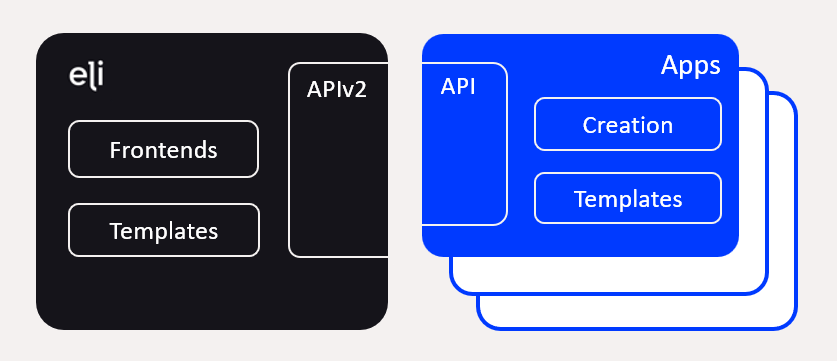
The following figure provides an overview of the methods and tools for engineering Eliona.
In detail, the following methods and tools are available:
* Frontend: interfaces for configuration and bulk data processing
* Templates: use of preconfigured configuration data
* API: extensive API interfaces
* Creation: automatic creation of configuration data
## Frontends
Eliona offers a comprehensive and user-friendly interface that enables many options for custom configuration. This interface also integrates the use of API interfaces for [**Apps** ](https://docs.buildings.ability.abb/collection/english-v14/apps/apps.md)and [**APIv2**](broken://pages/881be602140f4c897890a5b1fc9b2b16ccd2e55c) integrated. This makes it possible to configure and evaluate Eliona using preconfigured JSON data. The creation and configuration of large volumes of data is thus possible in a structured and defined format.
## Templates
Templates are used to simplify the creation of preconfigured configuration data.
Apps offer via **Dashboard Templates** the possibility to create specific dashboards for any user. The assets of the apps are displayed in a suitable way in typical dashboards and can then be individually adapted.
Eliona offers, through **Rule Chain Templates** the ability to automatically apply rules to a wide range of assets, thus saving the need to create identical rules.
## API interfaces
Eliona offers with the [**APIv2**](broken://pages/881be602140f4c897890a5b1fc9b2b16ccd2e55c) a comprehensive interface for querying and creating master and transaction data. The interface is JSON-based and can be used programmatically or ad hoc.
[**Apps** ](https://docs.buildings.ability.abb/collection/english-v14/apps/apps.md)also offer API interfaces to automate all app-specific configurations and query app data.
## Creation
Apps automatically create master and transaction data in Eliona as needed. Using [**Continuous Asset Creation**](https://docs.buildings.ability.abb/collection/english-v14/apps/app-sdk.md#continuous-asset-creation-cac) apps take over a large part of the configuration of device-specific apps. Assets are automatically created in Eliona and linked to the respective devices.
---
# Agent Instructions
This documentation is published with GitBook. GitBook is the documentation platform designed so that both humans and AI agents can read, navigate, and reason over technical content effectively. Learn more at gitbook.com.
## Querying This Documentation
If you need additional information that is not directly available in this page, you can query the documentation by asking a question.
Perform an HTTP GET request on the following URL with the `ask` and `goal` query parameters:
```
GET https://docs.buildings.ability.abb/collection/english-v14/for-developers/engineering.md?ask=&goal=
```
`ask` is the immediate question: it should be specific, self-contained, and written in natural language.
`goal` is what the user is ultimately trying to achieve, the reason they need the answer. Sharing it helps GitBook give you a better, more relevant answer. A goal is most helpful when it describes the outcome the user wants rather than restating the question. For example, with `ask=how do I create an API token`, a goal like `automate deployments from our CI pipeline` lets GitBook tailor the answer to that use case.
The response will contain a direct answer to the question and relevant excerpts and sources from the documentation.
Use this mechanism when the answer is not explicitly present in the current page, you need clarification or additional context, or you want to retrieve related documentation sections.