> For the complete documentation index, see [llms.txt](https://docs.buildings.ability.abb/collection/llms.txt). Markdown versions of documentation pages are available by appending `.md` to page URLs; this page is available as [Markdown](https://docs.buildings.ability.abb/collection/german-14.2-freezed/dokumentation/widgets/benutzerdefinierte-widgets/module/eingaben-and-schalter.md).

# Eingaben & Schalter

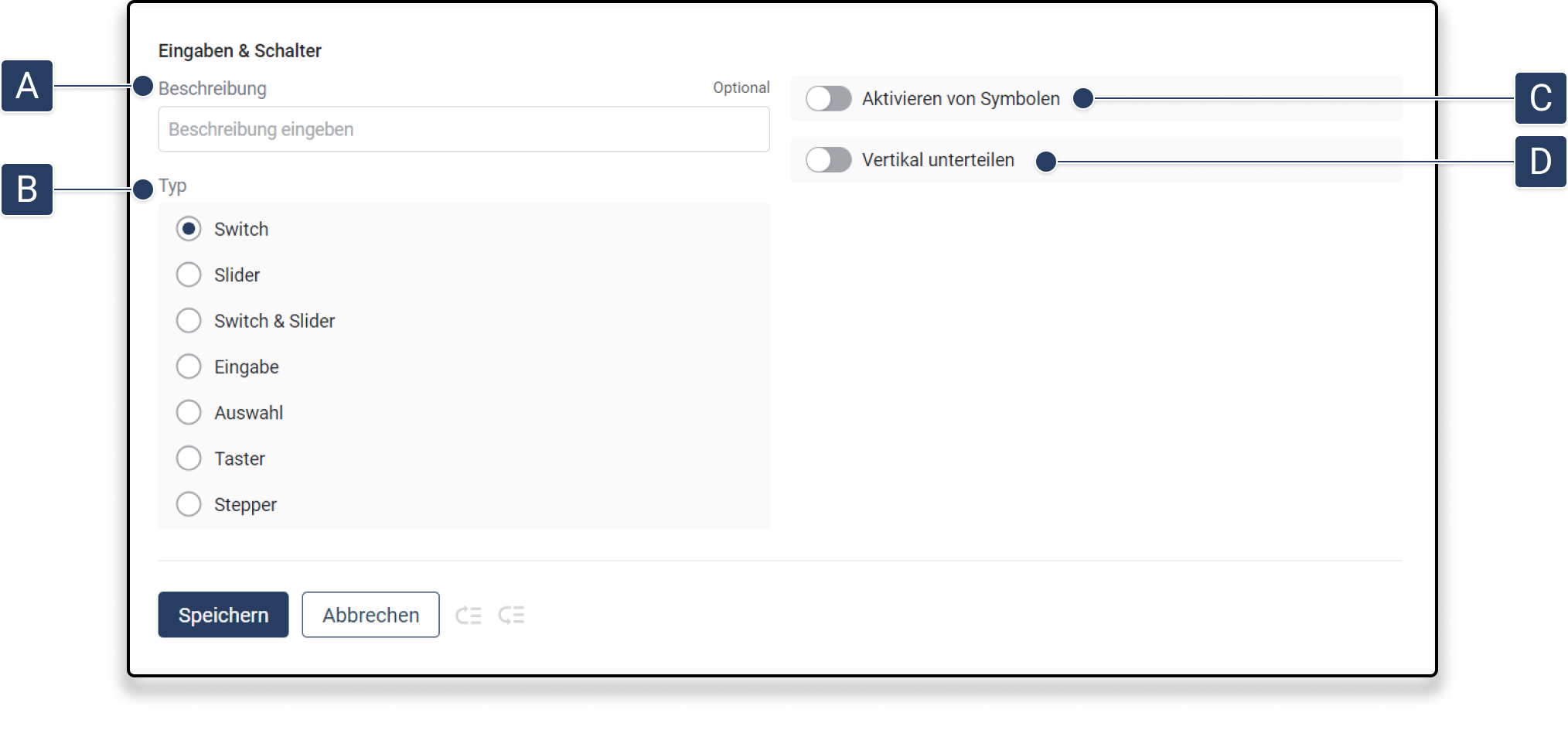
Mit dem Modul "Eingaben & Schalter" können Sie verschiedenste Schalter, Slider sowie Felder zur Eingabe von Werten in einem Widget darstellen.

<figure><img src="https://content.gitbook.com/content/Nyvwhz1kEMXcHf4HLuZ8/blobs/NekW25mEg2LJf4g43AgT/Input.png" alt=""><figcaption></figcaption></figure>

<table><thead><tr><th width="133.33333333333331"></th><th width="143"></th><th></th></tr></thead><tbody><tr><td><strong>[A]</strong></td><td>Beschreibung</td><td>Dieser Text wird angezeigt , wenn das Benutzerdefinierte Widget später mit Assets verbunden wird</td></tr><tr><td><strong>[B]</strong></td><td>Typ</td><td><ul><li><strong>Switch:</strong> Der Schalter ermöglicht es, ein Asset zwischen zwei Werten zu schalten</li><li><strong>Slider:</strong> Über einen Schieberegler kann ein Wert innerhalb eines Wertebereichs ausgewählt werden.</li><li><strong>Vertikaler Slider</strong>: Wie "Slider", aber der Schieberegler ist vertikal angeordnet.</li><li><strong>Schalter und Slider</strong>: Kombination aus "Slider" und "Switch"</li><li><strong>Eingabe:</strong> Ein Wert kann eingegeben werden.</li><li><strong>Auswahl:</strong> Über ein Drop-Down-Menü kann für jedes Asset aus mehreren Werten gewählt werden.</li><li><strong>Taster</strong>: Über einen Knopf können Sie Werte einstellen</li><li><strong>Stepper:</strong> Der Stepper ermöglicht die schrittweise Anpassung eines Wertes durch Inkrement- und Dekrement-Schaltflächen. Die Schritt weite kann im <em>Asset Template</em> konfiguriert werden. <a href="https://docs.buildings.ability.abb/collection/german-14.2-freezed/dokumentation/assets/asset-modellierung-templates-erstellen/ein-neues-template-erstellen.md#id-3-attribute-zum-template-hinzufugen">-> Grenzwerte im Asset Template</a></li></ul></td></tr><tr><td><strong>[C]</strong></td><td>Aktivieren von Symbolen</td><td>Bei Aktivierung werden die Symbole der zugehörigen Attribute angezeigt.</td></tr><tr><td><strong>[D]</strong></td><td>Vertikal unterteilen</td><td>Wenn aktiviert, werden die Eingaben nicht mehr untereinander, sondern auch nebeneinander angezeigt.</td></tr></tbody></table>


---

# Agent Instructions
This documentation is published with GitBook. GitBook is the documentation platform designed so that both humans and AI agents can read, navigate, and reason over technical content effectively. Learn more at gitbook.com.

## Querying This Documentation
If you need additional information that is not directly available in this page, you can query the documentation by asking a question.

Perform an HTTP GET request on the following URL with the `ask` and `goal` query parameters:

```
GET https://docs.buildings.ability.abb/collection/german-14.2-freezed/dokumentation/widgets/benutzerdefinierte-widgets/module/eingaben-and-schalter.md?ask=<question>&goal=<user_goal>
```

`ask` is the immediate question: it should be specific, self-contained, and written in natural language.
`goal` is what the user is ultimately trying to achieve, the reason they need the answer. Sharing it helps GitBook give you a better, more relevant answer. A goal is most helpful when it describes the outcome the user wants rather than restating the question. For example, with `ask=how do I create an API token`, a goal like `automate deployments from our CI pipeline` lets GitBook tailor the answer to that use case.

The response will contain a direct answer to the question and relevant excerpts and sources from the documentation.

Use this mechanism when the answer is not explicitly present in the current page, you need clarification or additional context, or you want to retrieve related documentation sections.