> For the complete documentation index, see [llms.txt](https://docs.buildings.ability.abb/collection/llms.txt). Markdown versions of documentation pages are available by appending `.md` to page URLs; this page is available as [Markdown](https://docs.buildings.ability.abb/collection/german/pflichtbasis/assets/asset-modeling-create-templates/create-a-new-asset-characteristic-template.md).
# Neue Anlagenmerkmalvorlagen erstellen
Asset-Charakteristikvorlagen ermöglichen es Ihnen, standardisierte Informationen für Assets zu definieren. Diese Vorlagen enthalten vordefinierte Attribute, die für bestimmte Asset-Typen relevant sind, wie z. B. Fläche, Kapazität oder Standort. Sie können bestehende Charakteristikvorlagen verwenden oder eigene erstellen und individuell anpassen.
1. Navigieren Sie zu **Engineering → Asset-Modellierung**.
2. Öffnen Sie ein beliebiges **Asset-Vorlage** durch Anklicken.
3. Klicken Sie auf **\[G1]** um die Übersicht der verfügbaren **Asset-Charakteristikvorlagen**.
▷ Eine Liste bereits vorhandener Asset-Charakteristikvorlagen wird geöffnet **\[G3]**.
4. Klicken Sie auf **\[G1]** um die verfügbaren **Asset-Charakteristikvorlagen**.
5. **Wählen Sie eine Kategorie aus oder erstellen Sie eine**
▷ Eine Liste vorhandener Asset-Charakteristikvorlagen wird geöffnet **\[G3]**.
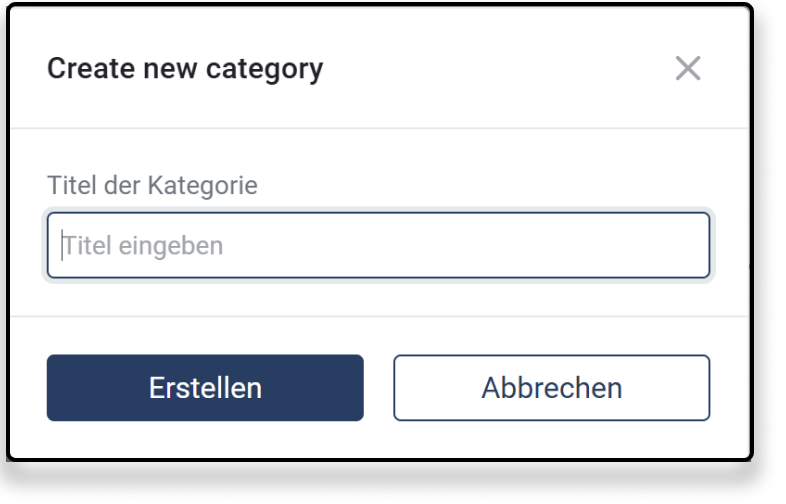
6. Um eine **neue Kategorie**, klicken Sie auf **\[G4]**.
▷ Das folgende Fenster wird geöffnet, um den Namen der Charakteristik festzulegen:
7. Um eine **vorhandene Kategorie zu bearbeiten**, klicken Sie auf **\[G5]**.
▷ Das Fenster **\[G6]** wird geöffnet.
8. In **\[G7]**, können Sie die **Übersetzungen** für die ausgewählte Kategorie verwalten.
9. Um ein **neues Attribut**, klicken Sie auf **\[G8]**.
10. Der **Attributtitel** wird in **\[G9]**.
11. Der **Einheit** des Attributs (z. B. m², Personen) wird in **\[G10]**.
12. Um die **Übersetzungen für ein Attribut hinzuzufügen**: Erweitern **\[G11]**.
13. In **\[G13]**, können Sie die Übersetzung für die jeweilige Sprache eingeben.
14. Weitere Sprachen können über **\[G12]**.
15. Übersetzungen können mit **\[G14]**.
16. Mit **\[G15]**, können Attribute zum Löschen beim Speichern markiert werden.
17. Klicken Sie auf **\[G16]** um alle Änderungen zu speichern.
Die konfigurierten Asset-Charakteristiken können dann direkt in den Asset-Vorlagen verwendet werden.
---
# Agent Instructions
This documentation is published with GitBook. GitBook is the documentation platform designed so that both humans and AI agents can read, navigate, and reason over technical content effectively. Learn more at gitbook.com.
## Querying This Documentation
If you need additional information that is not directly available in this page, you can query the documentation dynamically by asking a question.
Perform an HTTP GET request on the current page URL with the `ask` query parameter, and the optional `goal` query parameter:
```
GET https://docs.buildings.ability.abb/collection/german/pflichtbasis/assets/asset-modeling-create-templates/create-a-new-asset-characteristic-template.md?ask=&goal=
```
`ask` is the immediate question: it should be specific, self-contained, and written in natural language.
`goal` is optional and describes the broader end goal you are ultimately trying to accomplish on behalf of the user. GitBook uses it to tailor the answer towards what is most useful for that goal.
The response will contain a direct answer to the question and relevant excerpts and sources from the documentation.
Use this mechanism when the answer is not explicitly present in the current page, you need clarification or additional context, or you want to retrieve related documentation sections.