> For the complete documentation index, see [llms.txt](https://docs.buildings.ability.abb/collection/llms.txt). Markdown versions of documentation pages are available by appending `.md` to page URLs; this page is available as [Markdown](https://docs.buildings.ability.abb/collection/german/plattform/platform-core/baseline-and-factors/heating-and-cooling-days/configure-tenant-defaults.md).

# Mandanten-Standardwerte konfigurieren

Die Mandantenkonfiguration definiert die standardmäßigen Basistemperaturen, die für Assets verfügbar sind. Eine asset-spezifische Basistemperatur überschreibt den Mandantenstandard für dieses Asset.

Bevor Sie beginnen, [öffnen Sie Heiz- und Kühlgradtage](/collection/german/plattform/platform-core/baseline-and-factors/heating-and-cooling-days/open-heating-and-cooling-days.md).

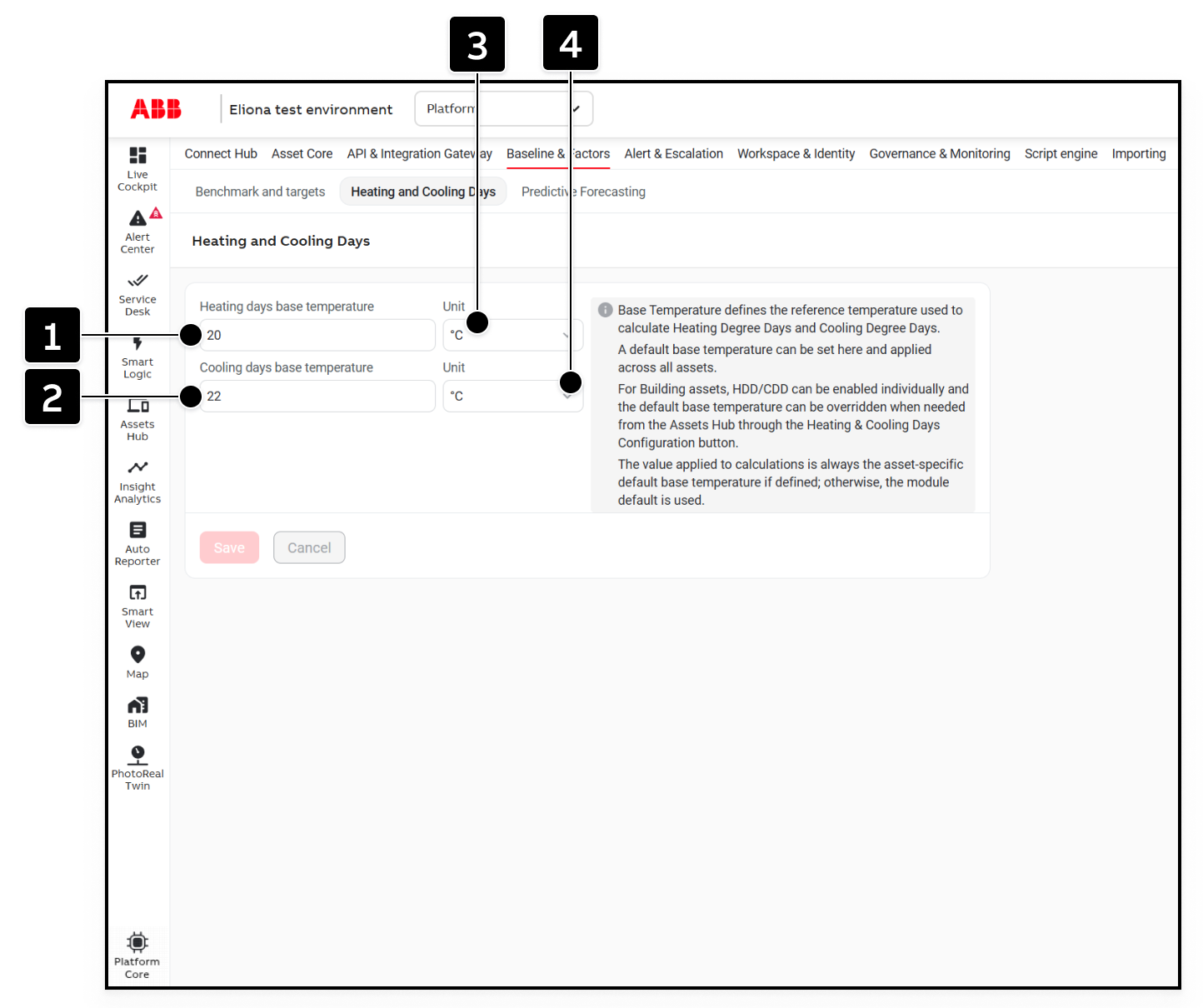
<figure><img src="https://2215908449-files.gitbook.io/~/files/v0/b/gitbook-x-prod.appspot.com/o/spaces%2FOqGnkz52o2zVUsEGEZGk%2Fuploads%2Fgit-blob-929454f1fdee0f64ff72294688abd9d41878dff1%2FConfigure%20Heating%20and%20cooling%20days%20tenant%20config.png?alt=media" alt="Heating and Cooling Days tenant configuration with base temperatures and units marked"><figcaption></figcaption></figure>

## Konfigurationsfelder

<table data-header-hidden data-search="false"><thead><tr><th width="55.51995849609375">Kennzeichnung</th><th width="185">Feld</th><th>Beschreibung</th></tr></thead><tbody><tr><td><strong>[1]</strong></td><td><strong>Basistemperatur für Heizungstage</strong></td><td>Standard-Referenztemperatur zur Berechnung von Heizgradtagen.</td></tr><tr><td><strong>[2]</strong></td><td><strong>Basistemperatur für Kühlungstage</strong></td><td>Standard-Referenztemperatur zur Berechnung von Kühlgradtagen.</td></tr><tr><td><strong>[3]</strong></td><td><strong>Einheit für Heizungstage</strong></td><td>Einheit für die Basistemperatur für Heizungstage: <strong>°C</strong> oder <strong>°F</strong>.</td></tr><tr><td><strong>[4]</strong></td><td><strong>Einheit für Kühlungstage</strong></td><td>Einheit für die Basistemperatur für Kühlungstage: <strong>°C</strong> oder <strong>°F</strong>.</td></tr></tbody></table>

## Standard-Basistemperaturen konfigurieren

1. Geben Sie die standardmäßige Basistemperatur für Heizungstage unter **\[1]** ein und wählen Sie die Einheit unter **\[3]**.
2. Geben Sie die standardmäßige Basistemperatur für Kühlungstage unter **\[2]** ein und wählen Sie die Einheit unter **\[4]**.
3. Klicken Sie auf **Speichern**.

Diese Werte sind Vorgaben. Wenn Heizgradtage oder Kühlgradtage für ein Asset aktiviert sind, wird seine Basistemperatur zunächst aus der Mandantenkonfiguration übernommen. Sie können dann den Standardwert beibehalten oder einen asset-spezifischen Wert eingeben.

[-> Heiz- und Kühlgradtage für ein Asset konfigurieren](/collection/german/plattform/platform-core/baseline-and-factors/heating-and-cooling-days/configure-heating-and-cooling-days-for-an-asset.md)


---

# Agent Instructions
This documentation is published with GitBook. GitBook is the documentation platform designed so that both humans and AI agents can read, navigate, and reason over technical content effectively. Learn more at gitbook.com.

## Querying This Documentation
If you need additional information that is not directly available in this page, you can query the documentation dynamically by asking a question.

Perform an HTTP GET request on the current page URL with the `ask` query parameter, and the optional `goal` query parameter:

```
GET https://docs.buildings.ability.abb/collection/german/plattform/platform-core/baseline-and-factors/heating-and-cooling-days/configure-tenant-defaults.md?ask=<question>&goal=<endgoal>
```

`ask` is the immediate question: it should be specific, self-contained, and written in natural language.
`goal` is optional and describes the broader end goal you are ultimately trying to accomplish on behalf of the user. GitBook uses it to tailor the answer towards what is most useful for that goal.

The response will contain a direct answer to the question and relevant excerpts and sources from the documentation.

Use this mechanism when the answer is not explicitly present in the current page, you need clarification or additional context, or you want to retrieve related documentation sections.
